Lunar Time
A racing stopwatch became NASA hardware, then lunar folklore. The Speedmaster’s strange magic is that it became mythic by remaining stubbornly practical.
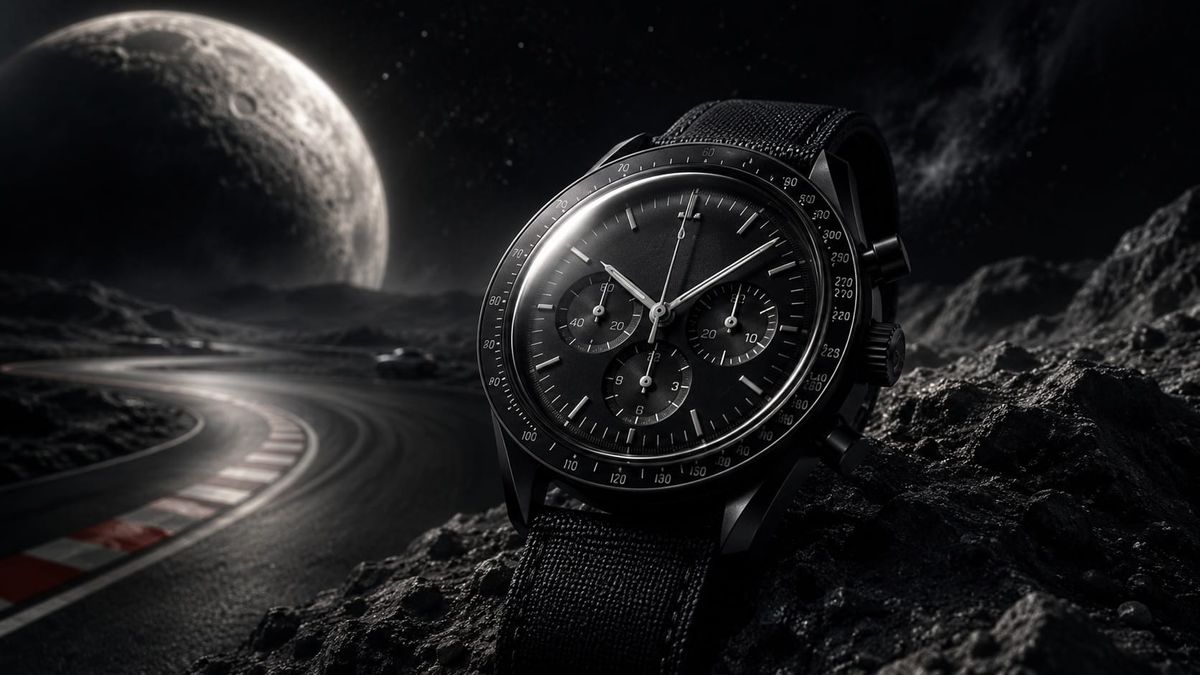
A story about how a practical stopwatch became the most famous timepiece in the solar system.
Of all the Speedmasters Omega will ever make, only a few will ever see outer space.
Most will live closer to Earth: laptops, steering wheels, airport lounges, maybe a conference room with lighting cruel enough to qualify as environmental testing. They’ll time steaks, parking meters, board games, and the occasional meeting that should have been an email.
And yet, the watch originally developed for sports cars now carries lunar dust in its bones.
That’s the odd gravity of the Moonwatch. It isn’t just a watch anymore, at least not in the ordinary luxury-object sense. It’s a small piece of machinery that escaped its category faster than Apollo escaped Earth’s atmosphere. It began life as a chronograph, a tool for timing things, and became one of the clearest pieces of object mythology in modern consumer culture.
Not because it was rare. Not because it was precious. Not because it was especially glamorous at first.
It became legendary because, for a few crucial moments, the math of spaceflight still needed a hand on a stopwatch.
Start there, and the story gets better.
The Race-Car Chronograph…
Before the Omega Speedmaster was “the Moonwatch,” it was a timing instrument. Omega introduced the Speedmaster in 1957, years before Apollo 11 and long before anyone could walk into a jeweler and say, “I’d like the one for lunar operations, please.”
It wasn’t the first chronograph. Wrist chronographs had existed for decades by then. Longines had put one on the wrist as early as 1913, and for generations before that, serious timing often meant a handheld stopwatch or pocket chronograph.
So the useful leap was not simply moving a stopwatch to the wrist. That job had already begun. The Speedmaster’s contribution was more specific: it made elapsed-time measurement feel like a purpose-built sports instrument. It had a clean, high-contrast dial, three readable subdials, pushers you could operate quickly, and a tachymeter scale moved out onto the bezel, where it could do its job without crowding the dial. It was not a dress watch with a timer attached. It was a small dashboard for seconds built for the racecar industry.
That was the Speedmaster’s first idea. A wristwatch made to tell time could also measure elapsed time clearly, quickly, and from the wrist. Racing, sports, aviation, technical work... anything where seconds mattered and the person measuring them preferred not to carry a separate stopwatch like a gym teacher with a whistle and a clipboard.
Inside, the early Speedmasters used Omega’s Calibre 321, a manually wound, column-wheel chronograph movement. It had not been built with NASA in mind, but it was serious enough to look, in hindsight, almost accidentally ready for the job.
That origin keeps the story honest. The Speedmaster wasn’t designed in a secret alpine laboratory for people in bubble helmets. It wasn’t born under a NASA purchase order. It was a commercially available watch that happened to be very good at something spaceflight still required: measuring intervals clearly, mechanically, accurately, and reliably.
A chronograph is, at its core, a stopwatch on the wrist.
That sounds simple enough.
Omega’s Liftoff…
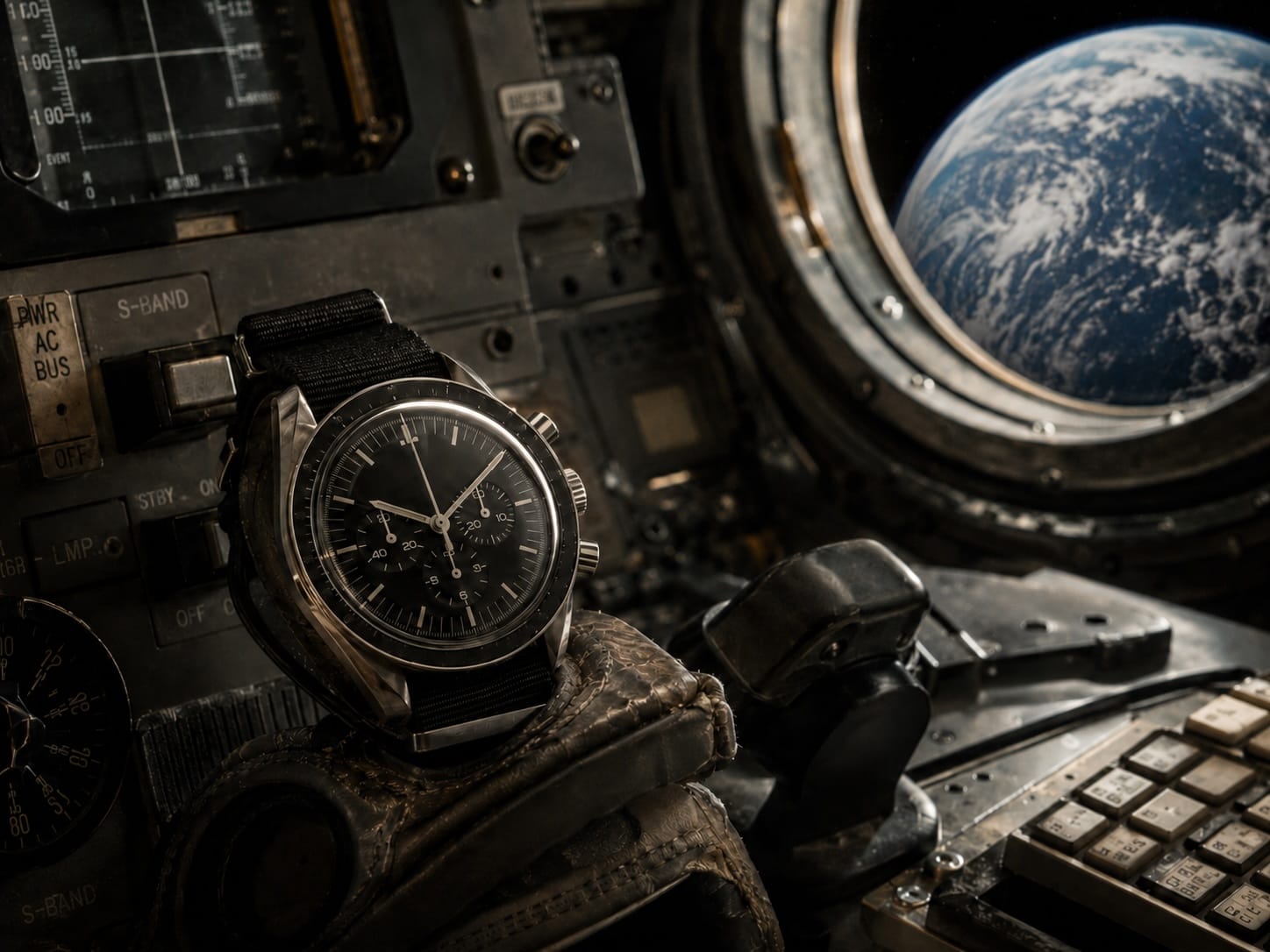
The Apollo program was full of computers, radios, procedures, checklists, simulators, and windowless rooms of people in short-sleeved white shirts doing math. But spaceflight is not math in the abstract. It’s math performed at a certain second, for a certain duration, under conditions where getting it slightly wrong can turn “return trajectory” into “historical tragedy.”
The equations might live in Houston. The timing still had to happen inside the spacecraft.
That can feel strange now. Modern spacecraft have layers of digital timing, onboard displays, automation, and redundancy. Astronauts still wear watches, but there’s less chance today that a wrist chronograph becomes the fallback instrument for a critical maneuver. Apollo lived closer to the edge between calculation and human execution. The computer could help. Houston could calculate. Procedures could tell the crew what to do.
But if a burn needed to last a precise number of seconds, someone still had to know when those seconds had passed.
The watch didn’t do the math. That matters. It wasn’t a calculator with hands. What it did was help make the math executable. If a procedure required a timed interval, that interval had to be measured by something still working when other things weren’t. A good watch didn’t replace mission control. It turned mission control’s calculations into action.
There’s something beautifully practical about that.