The Shape of Soccer
Before soccer balls became sensors and systems, the Telstar made the game visible. How a black-and-white pattern became the ball everyone remembers.
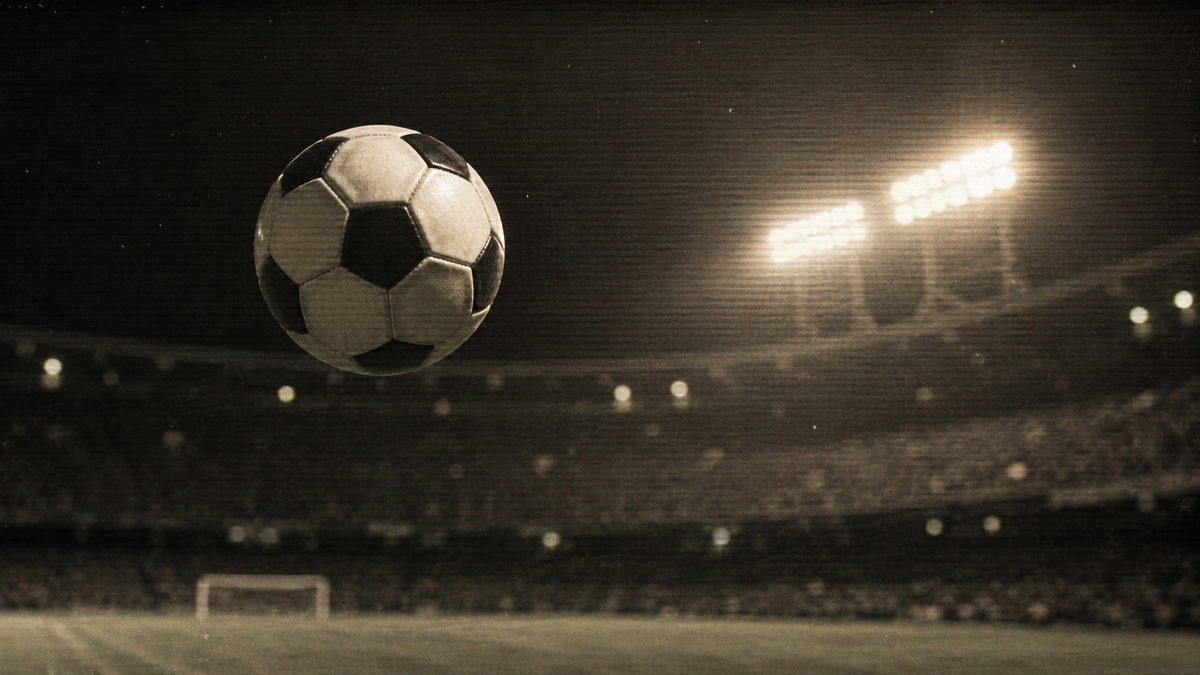
Try, for a moment, to think about a soccer ball in your head. Just a regular soccer ball.
Not an official match ball. Not whatever gleaming, sensor-filled, tournament-specific object Adidas has unveiled for the World Cup with a name that sounds like it came out of a branding meeting after the third espresso. Draw the soccer ball in your head.
Chances are, you're already drawing a white circle with black pentagons. Maybe the geometry is a little questionable. Maybe your hexagons have become distressed trapezoids. Maybe the whole thing looks less like a soccer ball and more like a beach ball with delusions of geometry. It doesn't matter. Everyone knows exactly what you're thinking of in your head.
Here's the fun part: that's not what most elite soccer balls look like anymore.
Modern match balls have become highly engineered objects…thermally bonded, aerodynamically tested, textured, branded, and increasingly wired into the game's officiating systems like VAR, short for video assistant referee (which is the replay-review system used to check goals, penalties, red cards, and offside decisions). The official ball for the 2026 FIFA World Cup, Adidas Trionda, isn't a humble black-and-white sphere. It has four-panel construction, graphics inspired by the three host nations, and connected-ball technology with a 500Hz motion sensor inside it. The ball now helps feed data to VAR systems in real time, which is useful if you enjoy soccer but have always felt it needed more science.
And yet, when the world thinks "soccer ball," it still tends to think of the Adidas Telstar.
Black pentagons. White hexagons. Mexico, 1970. Pelé. Television. Geometry. A ball that somehow became more than a ball.
The Telstar's story is interesting precisely because the ball looks, at first glance, so uncomplicated. It's a soccer ball. You kick it, chase it, lose it over a fence, and sometimes catch it in the ribs hard enough to briefly reconsider outdoor recreation.
But objects have a way of carrying more history than they first reveal.
A baseball isn't just cork, yarn, leather, and suspiciously emotional fathers. A golf ball isn’t just a little white ball you hit into the trees. And a soccer ball isn't just a pressurized sphere when it becomes the default symbol for the world's most popular game.
The Telstar didn't become famous simply because it was used in a World Cup. Plenty of objects appear at major sporting events and then retire quietly into equipment rooms, auction catalogs, forgotten display cases, and the shadowy drawer labeled miscellaneous athletic things no one knows what to do with. The Telstar became famous because it was developed at the intersection of global sport, television, industrial design, branding, and geometry. It solved a practical problem so gracefully that the solution became an afterthought. It made soccer easier to watch, easier to understand, easier to sell, easier to draw, and easier to remember.
A Ball Made for Television...
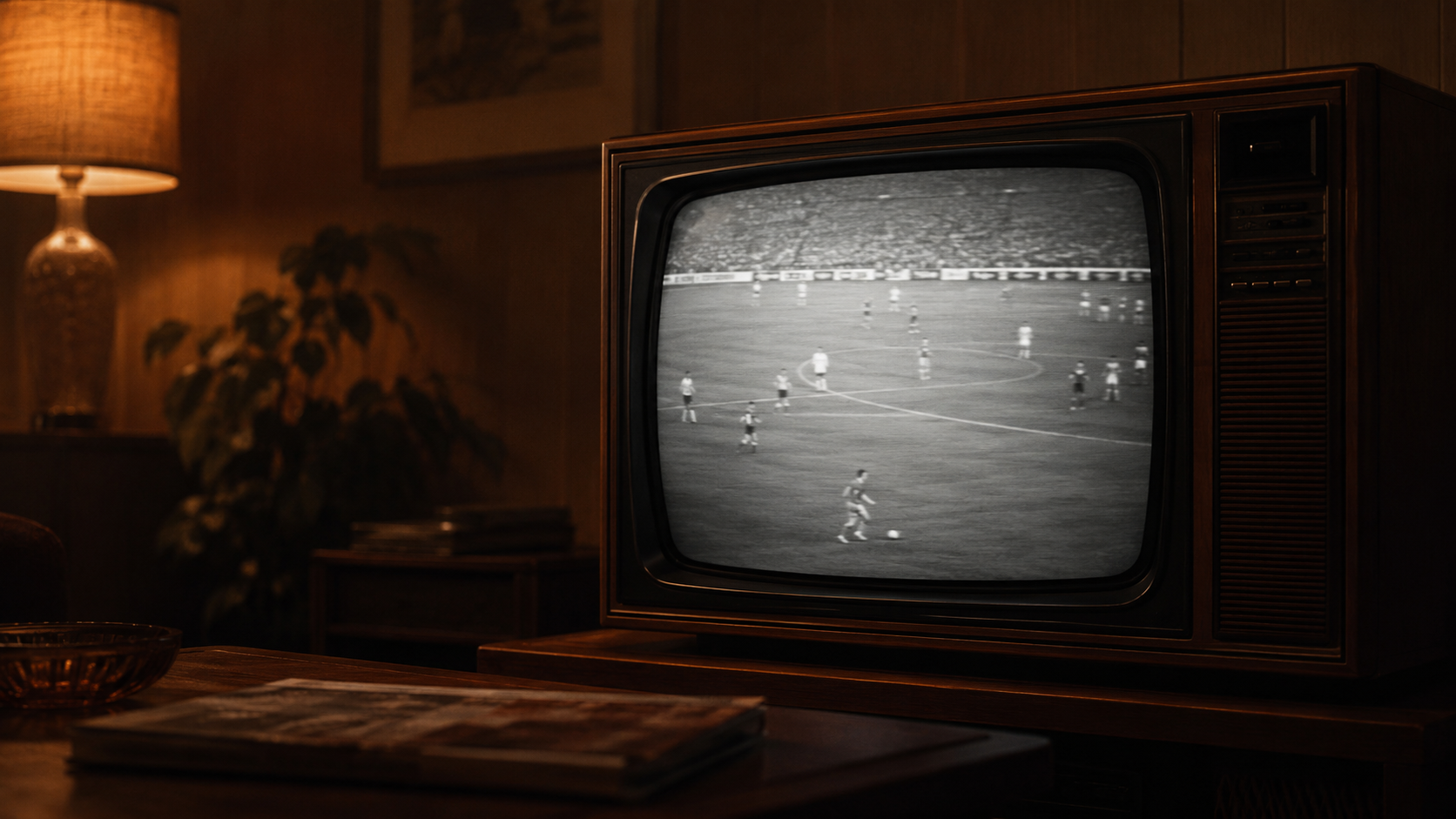
Before the Telstar, soccer balls were often brown or white leather objects, and on television they could be surprisingly easy to lose in the action. This wasn't a small issue. Soccer's a sport in which the small moving object is, inconveniently, the entire point. If the viewer lost sight of the ball in 1970, the game could become a collection of tiny black-and-white figures running purposefully around a rectangle, all apparently agreeing that something important had happened just off-screen.
Early television didn't merely show the game; it negotiated with it. Screens were smaller. Signals were softer. Cameras often stayed wider. Highlights had the crispness of a rain-soaked memory. A plain ball moving through grass, shade, mud, and twenty-two legs could turn into a pale smudge at precisely the moment a viewer needed clarity.
The 1970 World Cup in Mexico came at a moment when the sport was turning into a global television spectacle. It wasn't merely a tournament. It was a broadcast event. Millions of people were watching from around the world, and that changed what a ball needed to be. It still needed to be round, durable, kickable, and consistent. But now it also needed to perform for the camera.
Enter the Telstar, looking almost preposterously obvious in hindsight.
The Broadcast Finds Its Shape...
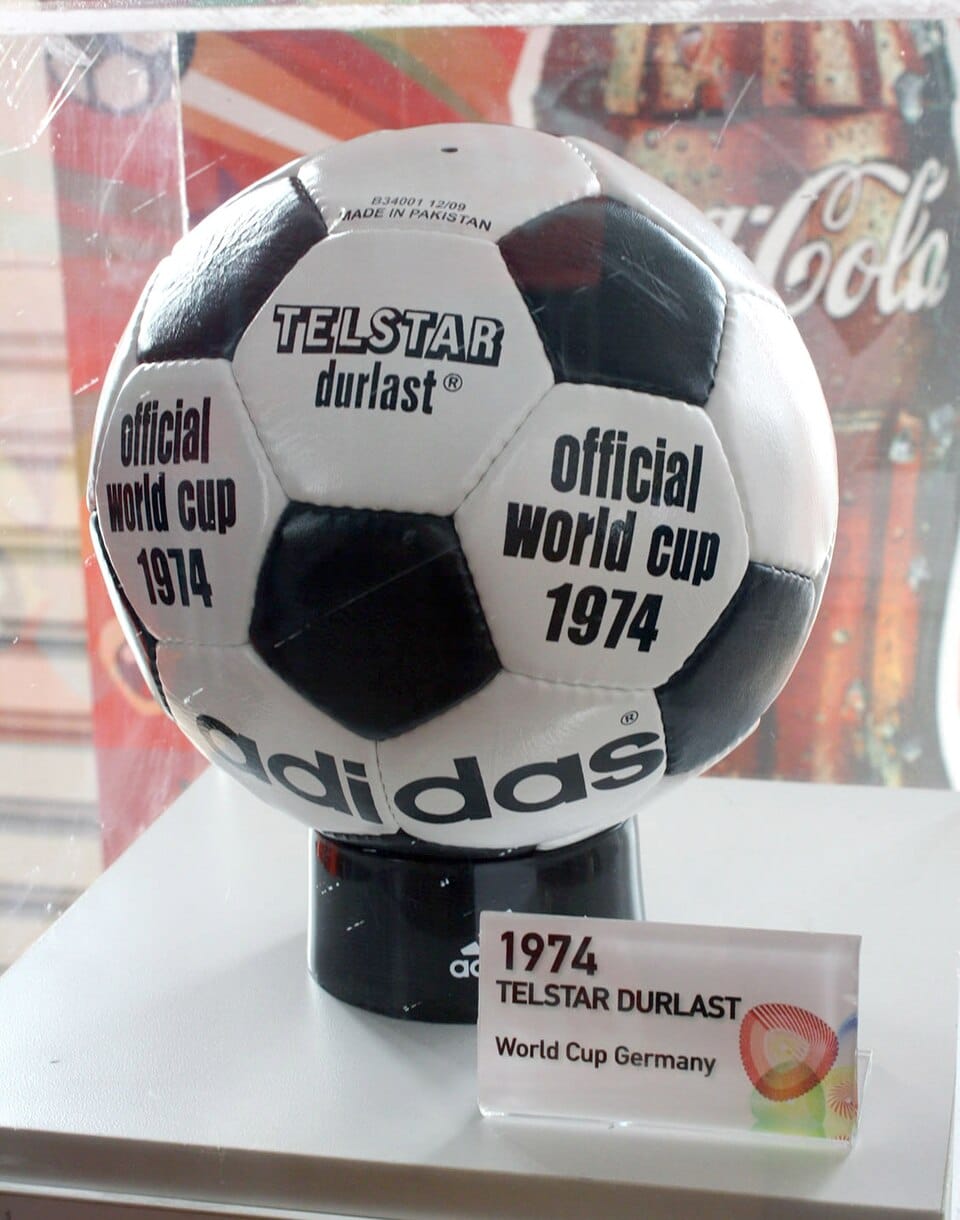
Adidas's 1970 World Cup ball used a black-and-white panel design: 12 black pentagons and 20 white hexagons. The structure is often described as a truncated icosahedron, said no soccer fan ever. But the idea is simple enough: stitch together a pattern of pentagons and hexagons, and you get something pleasingly spherical.
The black panels made the ball easier to see on black-and-white television, which was the practical breakthrough. Not magic. Not a whiteboard revelation followed by a slow clap. Just contrast. The ball stood out. Viewers could follow it. Its rotation was visible. It looked good on screen. It had, in the language of modern design, excellent user experience, assuming the user was a person squinting at a television set in 1970.
The first important thing to understand about the Telstar's debut is that it wasn't merely dressed for attention. It was made readable.
Readable design is underrated. We tend to think of great design as the invention of something entirely new, but often it's the discovery that an existing thing has been annoying everyone in a quiet, persistent way. A good design doesn't always announce itself. Sometimes it simply removes confusion.
The Telstar did that. It helped people see the game.
The name helped, too. "Telstar" is generally derived from "television" and "star," a name that practically announces its own era. It also echoed the communications-satellite age. Telstar 1, launched in 1962, helped open the era of transatlantic television transmission. The word already carried the shimmer of broadcast modernity: satellites, signals, television, the future arriving slightly out of focus. One Telstar helped television cross oceans. The other, the round one, helped television keep focus on the smallest and most important object on the pitch.
Here was a ball named for the television age, patterned for television visibility, appearing in the first World Cup where Adidas supplied the official match ball, just as global sport was becoming a shared screen experience.
Ordinary objects don't usually get such perfect timing. The Telstar did.
When the Workshop Meets the Broadcast...
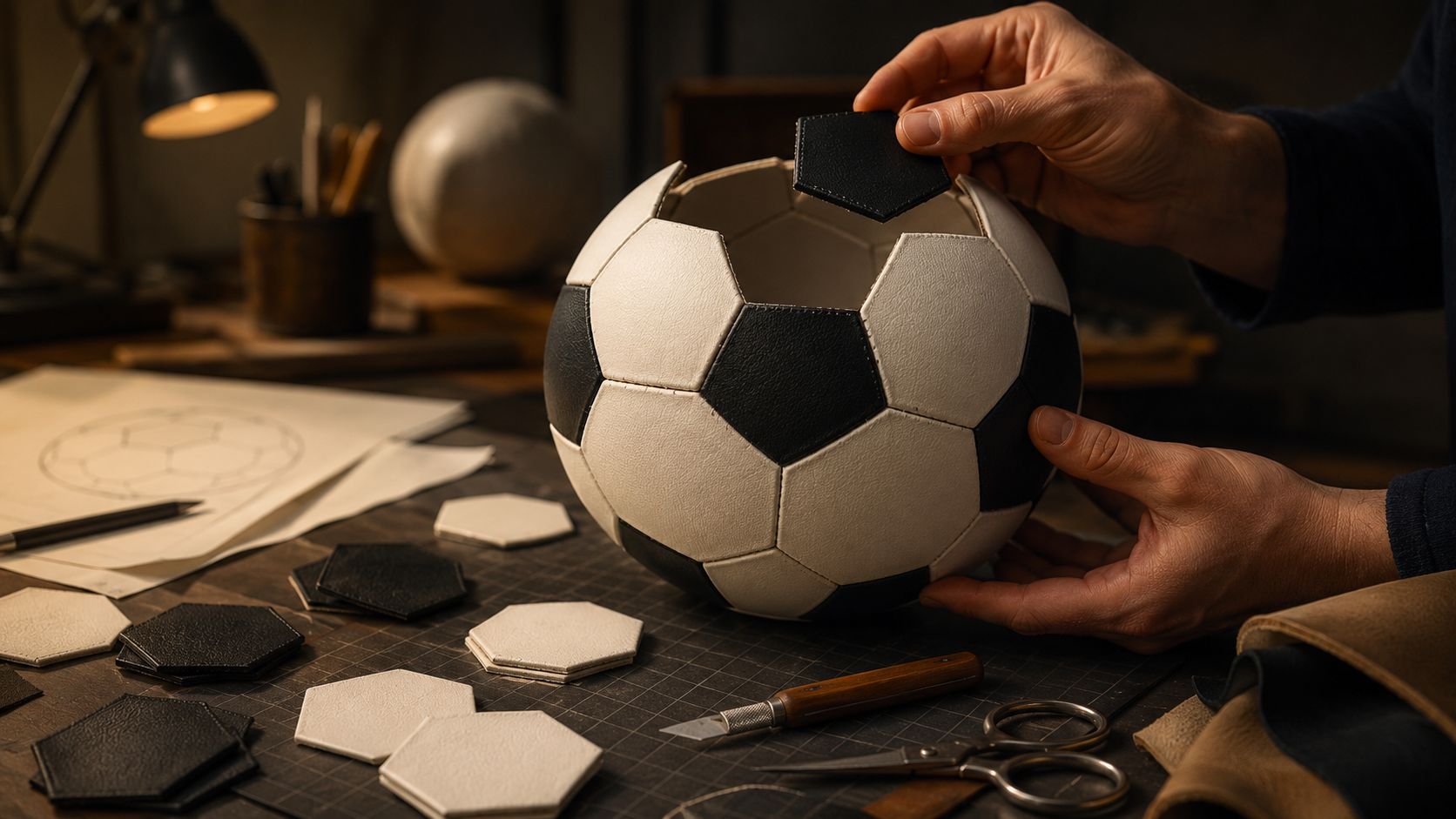
A useful caution point belongs here. Adidas didn't invent every part of the familiar 32-panel soccer ball. SELECT founder Eigil Nielsen had introduced a 32-panel construction in 1962, and public histories of the ball often credit him with that important architectural step. The safer, more accurate way to put it is this: Adidas didn't conjure the geometry from nothing. It brought a broadcast-ready version of that geometry to the world's biggest soccer stage and paired it with a high-contrast graphic that television could love.
That distinction is the story: invention belongs to the workshop. Icon-making belongs to the broadcast.
The Telstar became the ball people saw. Over and over. On television. In newspapers. In photographs. In advertisements. In shops. In children's books. On posters. Eventually, in the minds of people who had never watched the 1970 World Cup, never heard of a truncated icosahedron, and would've been perfectly happy never to hear of one again.
It became a symbol because it could be reduced. A child could draw it. A toy company could echo it. A sign maker could suggest it with a few shapes. A television viewer could track it from the sofa. A global sport could compress itself into one instantly recognizable object.
The real reason the Telstar was perfect? It wasn't just beautiful. It was useful at every scale.
On the field, it was a ball. On television, it was a visible ball. In print, it was a graphic. In advertising, it was a logo waiting to happen. In memory, it was simple enough to stay.
The Ball Everyone Learned to Draw...
But why does the Telstar feel older and yet appear more modern than it actually is? It belongs to 1970, sure, but it still looks like the idea of a soccer ball in your mind today. There's a sharp, almost mid-century confidence to it. The black-and-white contrast. The repeating geometry. The cheerful implication that the world can be organized into shapes and then kicked very hard by Brazilians.
It's not hard to see why the image stuck.
Most sports have visual shorthand. Baseball has the red stitching. Basketball has orange leather and black seams. American football has the brown prolate spheroid, bet you didn't know that. Soccer has the Telstar pattern. It's the cartoon version, the emoji version, the clip-art version, the version that survives even after the professional object has moved on.
From Camera Object to Data Object...
And professional soccer balls have very much moved on.
The history of World Cup balls after the Telstar is basically the history of the ball becoming less like an old leather object and more like a piece of sports technology. Materials changed. Water resistance improved. Leather gave way to synthetics. Stitching evolved. Panels were reduced, reshaped, bonded, textured, tested in wind tunnels, and given names that sound as if they should be accompanied by orchestral music.
The 1986 Azteca was the first fully synthetic World Cup match ball. The 2006 Teamgeist moved away from the traditional 32-panel construction and used 14 thermally bonded panels. The 2018 Telstar 18 nodded back to the original, but even that homage arrived with an NFC chip…the same broad family of close-range contactless technology behind tap-to-pay…because nostalgia is apparently now required to be interactive.
Then came connected-ball technology. The 2022 World Cup ball, Al Rihla, included internal sensor technology used to support semi-automated offside decisions. The 2026 Trionda continues that evolution with a sensor that can record motion at 500Hz and send data to officiating systems in real time. In practical terms, the ball isn't just seen. It's read.
The leap from Telstar to Trionda feels almost scripted.
The Telstar was designed for cameras.
The Trionda is designed for systems.
The Telstar told the viewer, "Here's the ball."
The Trionda tells VAR, "Here's the ball, here's its acceleration, here's the possible touch, here's the exact timing, and please prepare several replay angles so half the stadium can experience legal uncertainty."
No one's complaining about the advancements, though, unless your team is the one offside. Games that were once interpreted by the eye are now interpreted by networks of cameras, chips, sensors, and people in headsets studying a freeze-frame of someone's kneecap drifting a fraction beyond the second-to-last defender. The ball has changed because the audience has changed. The broadcast has changed. The officiating has changed. The expectations have changed.
The Thing We Stopped Seeing...
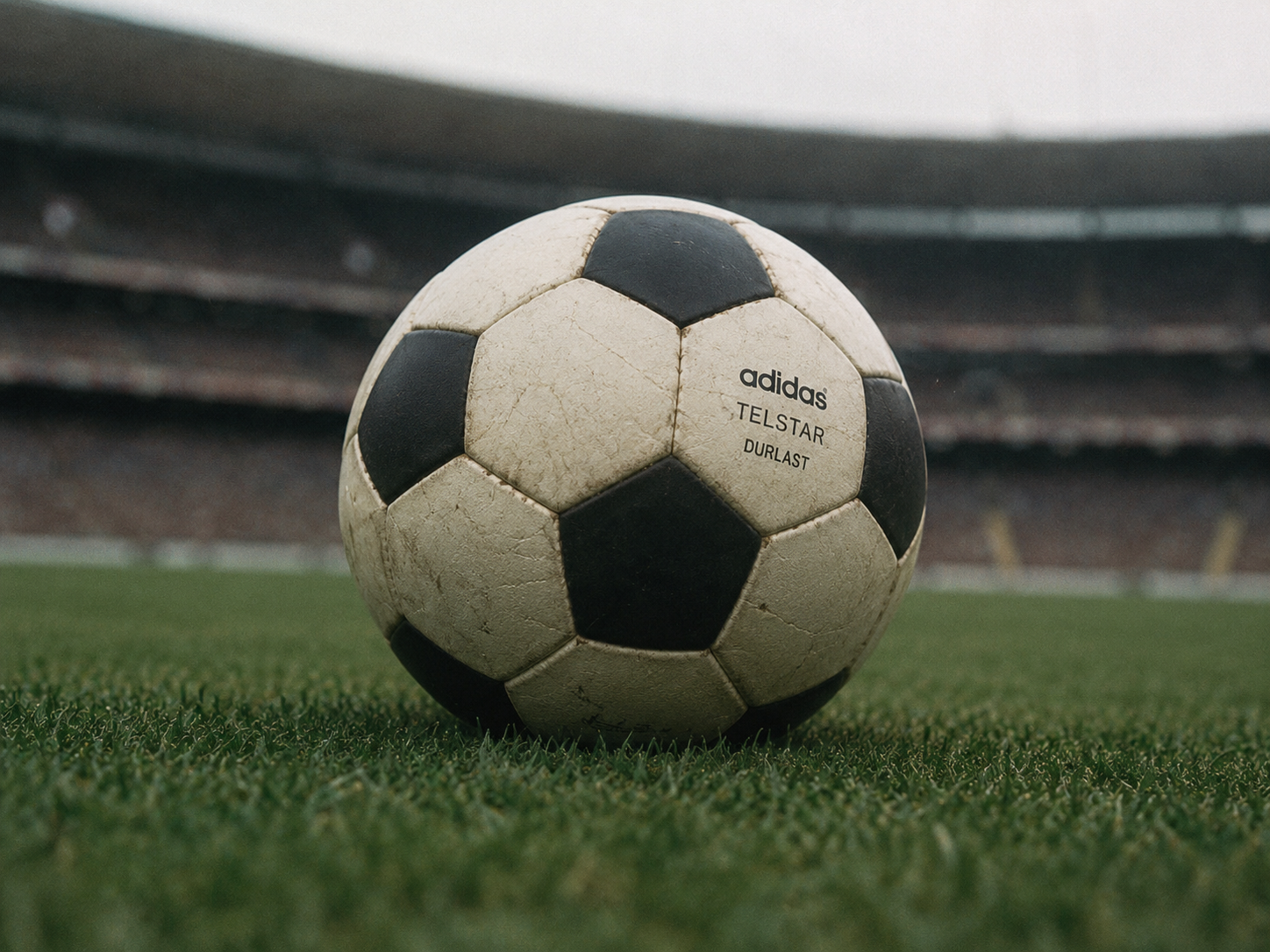
That brings us back to the Telstar, which looks simple only because its dated technology remains very familiar.
In 1970, making a ball work better on television wasn't trivial. It was an act of media design. It recognized that the game no longer existed only between the touchlines. It existed in living rooms, on screens, across borders, in the shared imagination of viewers who were nowhere near the stadium.
Calling the Telstar "iconic" isn't just lazy nostalgia, though nostalgia is certainly lurking nearby in a tracksuit. The ball became iconic because it did several jobs at once. It worked as equipment. It worked as broadcast design. It worked as branding. It worked as geometry. It worked as memory.
Most objects don't get to do that. Most objects are lucky if they do one thing well without injuring someone.
The Telstar solved a practical problem beautifully. It made the central object of the world's most popular game more visible at the exact moment the world was learning to watch that game together. Then, because the design was so clear, it escaped the tournament and entered culture. It became the ball on playgrounds, birthday cakes, cartoons, stickers, school notebooks, and eventually the little mental sketch almost everyone carries around.
That's the final trick of the Telstar. It became so familiar that we stopped seeing it as designed.
We think of it as natural. As generic. As simply "a soccer ball."
But it's not generic. It's a very specific answer to a very specific historical moment: What should a soccer ball look like when the world is watching through a black-and-white television?
The answer was black pentagons, white hexagons, and enough contrast to survive the rabbit-ear analog haze.
In 2026, the World Cup ball will be read by sensors, tracked by software, and argued over by officials with enough data to make a targeted-ad platform take notes. That ball belongs to our moment. It's designed for a world where sport isn't only watched but virtually measured.
The Telstar belonged to an older threshold. It was designed for the moment when sport first became truly visible at a global scale.
A ball designed for television became the ball in the world's imagination.
Which is why, when someone asks you to draw a soccer ball, you probably still draw 1970.
Source Notes...
These notes are meant to give curious readers a trail, not to turn a Telstar essay into a FIFA equipment manual. This piece draws on FIFA and adidas ball histories, Smithsonian collection records, SELECT’s account of the 32-panel football, official connected-ball technology releases, IFAB’s Laws of the Game, NIST’s NFC definition, and NASA/Smithsonian material on the Telstar satellite.
Telstar, 1970, and the ball people remember. The official starting point is FIFA’s The adidas Telstar begins ball chain, which supports adidas becoming the official World Cup match-ball supplier in 1970, earlier host-country ball practices, the Telstar name, 32 leather panels, and black-panel visibility on black-and-white televisions. The Smithsonian National Museum of American History’s Soccer Ball object page is the best museum anchor for the 32 hand-stitched panels, 12 black pentagons and 20 white hexagons, leather material, television visibility, and the Telstar’s 1970 World Cup use.
32-panel geometry and careful credit. For the precision point that the familiar 32-panel football predates the Telstar, see SELECT Sport’s football-manufacturing/history page, which credits SELECT founder Eigil Nielsen with introducing the 32-panel ball in 1962 and describes the 20-hexagon, 12-pentagon construction. I kept the article careful here: Nielsen/SELECT receives credit for the architectural step, while adidas receives credit for bringing a broadcast-ready, high-contrast version of that geometry to the World Cup stage. I did not find strong primary support for saying adidas licensed, acquired, stole, or disputed the geometry.
World Cup ball evolution after Telstar. adidas’s Complete History of adidas World Cup Match Balls is useful for the post-Telstar equipment arc: the Tango visual lineage, the 1986 Azteca’s synthetic materials, the 2006 +Teamgeist move away from traditional 32-panel construction, the 2018 Telstar 18 NFC chip, and the 2026 Trionda’s host-nation symbolism and connected-ball framing.
Trionda and connected-ball technology. For current-ball details, adidas’s Trionda campaign page supports Trionda as the FIFA World Cup 26 official ball, the host-nation and la ola design inspiration, the four-panel design, thermally bonded seamless construction, textured surface, predictable trajectory, and lower water uptake. Atlanta United/adidas press release syndication gives the sharper technology details: a side-mounted chip system, 500Hz IMU motion sensor, counterweights, real-time VAR data transmission, faster offside support, and individual touch identification.
Al Rihla, VAR, and offside wording. adidas’s 2022 Al Rihla connected-ball press release supports the connected-ball precedent: a 500Hz IMU sensor, KINEXON collaboration, real-time ball data to match officials, and semi-automated offside support. IFAB’s Law 11 is the source for the article’s offside language, including the opponents’ half, being nearer to the opponents’ goal line than both the ball and the second-last opponent, and the exclusion of hands and arms when judging offside position.
NFC and reader-friendly tech translation. For the NFC chip in Telstar 18, NIST’s Near Field Communication definitionis a useful public reference for describing NFC as close-proximity, contactless radio communication based on RFID technology. I kept that explanation light because the article’s point is not to explain NFC standards, only to orient readers to the kind of technology involved.
The Telstar satellite and broadcast modernity. NASA’s Telstar Opened Era of Global Satellite Television supports the larger communications-satellite context: Telstar 1 launched in 1962, relayed live television pictures across the Atlantic, and helped open the era of live-via-satellite broadcasting. The Smithsonian National Air and Space Museum’s Telstar object pageanchors Telstar as the world’s first active communications satellite, its AT&T development, and its early transatlantic television role. These sources support the article’s claim that the soccer ball’s name carried the shimmer of the television and satellite age.
Image note: Historical photographs and archival images in this article are credited in their captions where applicable. Other images, unless otherwise credited, may be AI-generated editorial illustrations created for Detours & Footnotes and are intended as visual interpretations, not documentary photographs.